Why You Should Stop Swiping Away That Stand Notification
Stop Swiping Away That Stand Notification
What 60 seconds actually buys you
It's 3:40pm. The deck is due tomorrow, slide 14 is a disaster, and you have that specific tightness behind your eyes that means you've been staring at the same thing for too long.
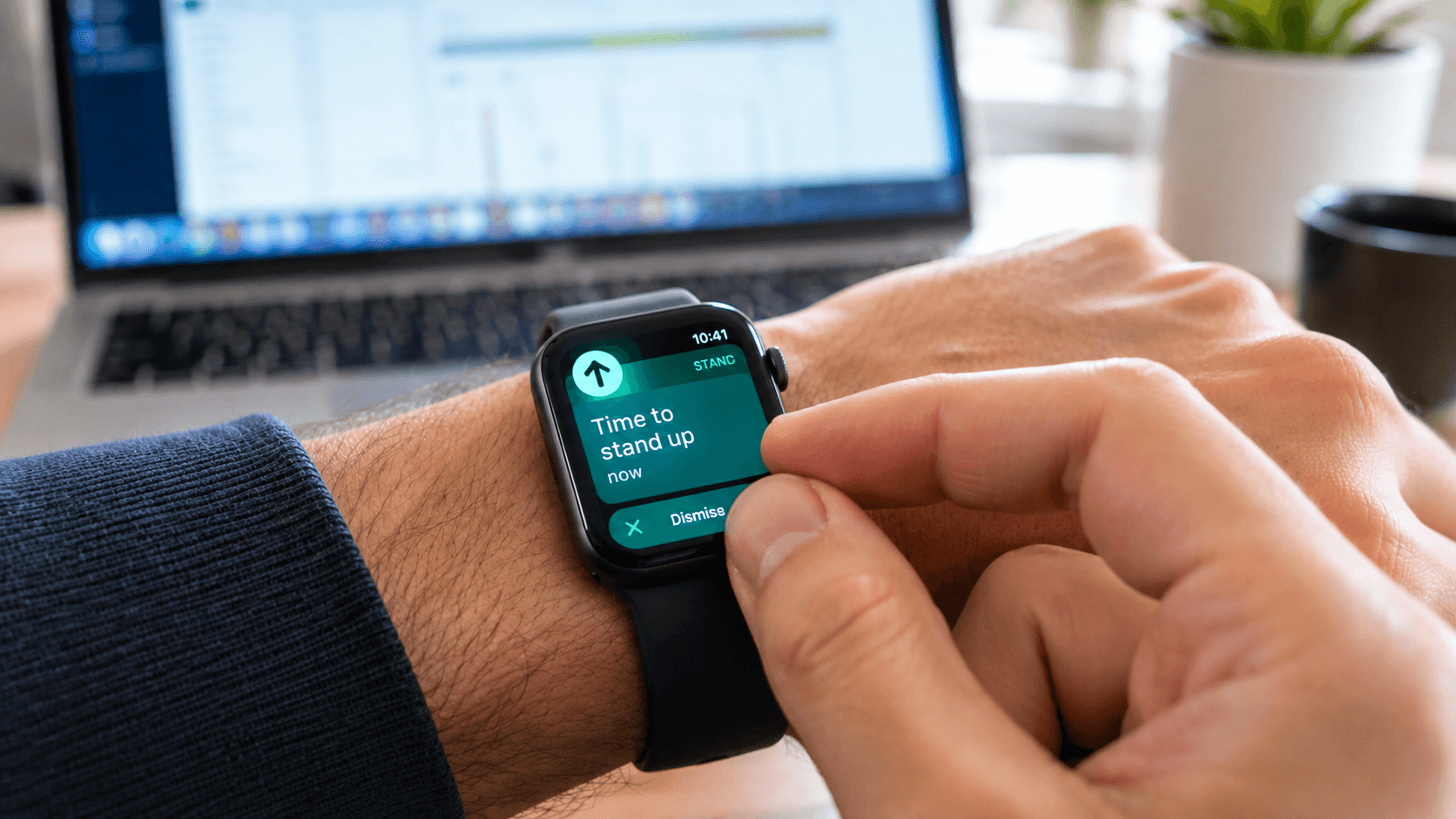
Buzz. Time to stand.
You swipe it away without reading it. Obviously. You're in the middle of something.
Here's the thing though — the swipe is a trade. You're spending sixty seconds to keep something. The question nobody actually asks is what those sixty seconds were worth.
Turns out we can put numbers on it.
1. The numbers are absurdly good for the price
This is the part that surprised me. For an intervention that costs one minute, the measured effects are not small.
24–30% lower blood glucose spike. In a randomised crossover trial at Baker IDI in Melbourne, overweight adults sat for five hours after a test meal — either straight through, or interrupted every 20 minutes with two minutes of walking. The walkers' glucose response dropped 24–30%, and insulin 23%. The authors noted that's comparable in magnitude to a full bout of moderate exercise.
In lean, healthy adults, 37%. A separate trial found short activity breaks beat a single continuous 30-minute walk at controlling post-meal glucose. Not matched. Beat.
Even chair stands work. One study found 1 minute of repeated sit-to-stands every 30 minutes was as effective as 2-minute treadmill walks for lowering post-meal insulin. You don't need a gym. You need to get out of the chair.
And a 2026 meta-analysis of 39 trials confirmed it across the board — breaks every 15–20 minutes gave the largest effect, and walking beat standing still by a wide margin.
One minute of walking, several times a day, does something to your metabolism that a single gym session cannot replicate. These aren't substitutes. They're different tools.
2. Yes, this applies even if you work out
The standard defence: "I go to the gym, I'm covered."
The Lancet ran the biggest test of that claim in 2016 — a harmonised meta-analysis across more than one million people. The finding: sitting 8+ hours a day does raise mortality risk, and it's fully offset only by roughly 60–75 minutes of moderate activity every single day.
Three out of four people in that dataset didn't hit it.
So unless you're doing an hour-plus daily — not four times a week, daily — the chair is still charging you. Your 45-minute gym session is excellent. It is not a receipt that clears the balance.
3. Now the part that matters at 3:40pm
Everything above is about your fifties. Here's what it does to the next two hours.
Fatigue drops measurably. In a controlled trial, adults who took 3-minute light walking breaks every 30 minutes reported significantly lower fatigue at both the 4-hour and 7-hour marks than people who sat straight through. Same day. Same work. Just less depleted at the end of it.
Attention actually improves. A study of walking breaks every 30 minutes found improved attention and executive function versus 5 hours of uninterrupted sitting. EEG work has shown walking breaks raise attention-related brain activity directly. And the frequency matters more than the duration — short, regular breaks improve cerebral blood flow more than one long one.
Your brain gets more blood. That's not a metaphor. Prolonged sitting measurably reduces blood flow to the brain, and movement breaks reverse it.
So the actual trade at 3:40pm isn't "sixty seconds versus my deck." It's:
- Sixty seconds, and come back with better attention to slide 14, or
- Stay put, and grind through the next hour with a brain running on lower blood flow, higher fatigue, and rising glucose from lunch. You're not protecting your focus by staying seated. You're spending it.
4. Ask any engineer where bugs get fixed
Not at the desk. On the walk to the water cooler.
This one has a name — the incubation effect. When you're stuck, you're usually stuck on a wrong assumption you can no longer see, because you've been holding it for forty minutes. Standing up breaks the loop. The answer arrives on the way back with the water bottle, unreasonably often.
The stand reminder is, entirely by accident, a Pomodoro timer you never configured and can't forget to start. It's the only thing in your day willing to interrupt a bad hour.
Making it survive contact with a real workday
- Walk, don't stand. The data is clear that standing still is the weakest version. Even pacing your room counts.
- 60 seconds is enough. The trials showing big effects used 1–3 minutes. This is a rounding error on your afternoon.
- Do it at the hour, not at hour 4. Frequent short breaks beat one long one. Eight breaks spread out beat guilt-pacing at 11pm.
- Pair it with something. Water refill, tea, closing a window. Habits stick to other habits.
- If it makes you anxious, turn it off. It's a tool. Configure the tool.
The whole ask
Sixty seconds. Roughly nine times a day.
In exchange: a metabolic effect that rivals a workout, measurably less fatigue by evening, sharper attention for the thing you're already struggling with, and a decent shot at solving it on the walk.
That's not an interruption to your work.
That's an incredible performance upgrade and it's currently buzzing on your wrist, being ignored, haha!.
Go on. Stand up.